


The Office for Budget Responsibility (OBR) has published its 2025 Fiscal Risk and Sustainability (FRS) report, marking another important milestone in how the UK assesses the resilience of its public finances. It is encouraging to see a growing focus on long-term sustainability and risk awareness but much of what we’re seeing now is not new.
The OBR has been flagging structural risks since 2011 through its Fiscal Sustainability Reports, and later through the biennial Fiscal Risks Reports (2017–2021), before combining the two in 2022.
The latest report, published in July 2025, highlights several persistent and worsening challenges:
Pensions: A Time Bomb in Slow Motion
The UK’s pension system was created in 1908 with the Old Age Pensions Act, when average life expectancy was just 51 years. Today, thanks to modern medicine and public health improvements, life expectancy has nearly doubled — with significant implications for the affordability of retirement income. At the same time pensions have moved from being means tested to being available universally.
Despite several reforms, including automatic enrolment (2012) and the shift from defined benefit to defined contribution schemes, the public sector continues to bear much of the risk. State pensions remain the second largest area of public spending after the NHS — and this burden is only increasing, especially under the triple lock guarantee.
Let’s be clear:
- The triple lock is politically popular, but fiscally unsustainable in the long run.
- National Insurance contributions do not directly fund pensions or healthcare — there is no ringfencing. Today’s taxpayers fund today’s pensions.
- The rising cost of social care, largely borne by local governments, only deepens the financial strain.
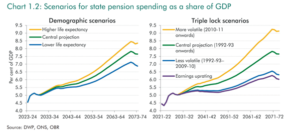
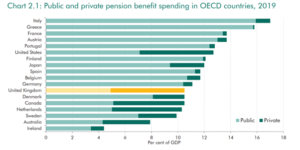
While projections show UK pension spending is lower than some OECD peers (Italy, for instance, spends more as a percentage of GDP), the long-term trajectory is worrying. Reform is necessary but remains politically unpalatable.
Government Balance Sheet: Transparency, Finally?
It is welcome news that the government is finally turning attention to the balance sheet an essential, yet often overlooked, part of fiscal sustainability.
Understanding what the state owns and owes is crucial to assessing whether long-term liabilities are manageable. The IMF has long advocated for this through its push for Public Sector Net Worth (PSNW) as a more comprehensive fiscal anchor.
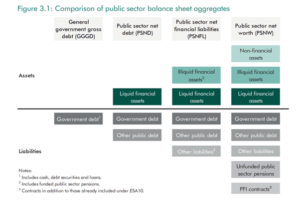
The UK has made some progress:
- New fiscal rules now refer to net liabilities, a step forward in transparency compared to the narrow debt-focused targets of the past.
- The Whole of Government Accounts (WGA) offers a broader, if delayed, perspective on financial health.
- The OBR’s working paper on PSNW is an excellent primer for those interested in the technical detail (read it here).
But challenges persist. A recent Public Accounts Committee (PAC) report has warned that poorly managed Private Finance Initiative (PFI) contracts may leave the public sector holding low-quality assets another long-term liability we can’t ignore. (PAC July 2025 report)
2 Another excellent paper explaining public sector net worth was prepared by the OBR https://obr.uk/docs/PSNW-working-paper-No16.pdf
Climate Change: Delays Will Cost More
The recent UK heatwaves are yet another reminder that climate change is no longer a future risk, it’s a current reality.
The FRS rightly includes climate among the top fiscal risks, but the cost of inaction continues to grow. Every year of delay increases the eventual cost of mitigation and adaptation and increases the strain on future public finances.
Moral Hazard and the Cost of Safety Nets
The UK government has had to step in during several major global shocks:
- The global financial crisis
- The COVID-19 pandemic
- The Russia–Ukraine conflict and its economic fallout
Each response was necessary. But there is growing concern that this has created a moral hazard a public expectation that the government will always act as the insurer of last resort.
Yet the room to manoeuvre is shrinking:
- UK debt interest costs now exceed £104.9 billion (8.2% of total spending)
- National debt is higher than the G7 average
- Taxes are at historically high levels
- The cost-of-living crisis continues to weigh on households
The uncomfortable reality is this:
To secure the long-term sustainability of the UK’s public finances, the government will need to choose between:
- Higher taxes
- More borrowing
- Lower spending
None of these options are politically attractive. And none are vote winners.
❓ What Would You Do?
The OBR’s July 2025 Fiscal Risk and Sustainability report is not just a technical document. It’s a mirror held up to our political economy — and it forces us to confront hard questions.
If you were in charge of fiscal policy, how would you balance long-term sustainability with short-term pressures?
Raise taxes? Cut spending? Reform pensions?
Full report here: OBR Fiscal Risks and Sustainability Report – July 2025